What Is Catholic Confirmation?

In the sacred hush of the Upper Room on Pentecost, the Apostles were enveloped by the Holy Spirit's descent as tongues of fire, empowering them to proclaim the Gospel with unyielding courage (Acts 2:1-4). This divine outpouring mirrors the profound grace bestowed in the Sacrament of Confirmation, a cornerstone of Christian initiation in the Catholic Church. As faithful followers of Our Lord Jesus Christ, we are called to receive this sacrament to strengthen our baptismal vows and become bold witnesses in a world often shadowed by secularism. Rooted in unchanging apostolic tradition, Confirmation seals us with the Holy Spirit, equipping us for spiritual combat and missionary zeal. This article delves into the meaning of the Confirmation sacrament, its biblical basis, symbols, effects, and preparation, drawing from Sacred Scripture, the Church Fathers, and the Catechism of the Catholic Church to illuminate this path to sanctity.
The Biblical Foundations of Confirmation in Catholicism
The Sacrament of Confirmation finds its roots deeply embedded in Sacred Scripture, where the Holy Spirit's role in strengthening the faithful is vividly portrayed. In the Acts of the Apostles, we see clear precedents for this sacrament. For instance, after Philip baptized the Samaritans, Peter and John "laid hands on them, and they received the Holy Spirit" (Acts 8:14-17). This imposition of hands, distinct from baptism, conferred a special outpouring of the Spirit, enabling the newly baptized to fully participate in the Church's mission.
Similarly, in Acts 19:1-6, Paul encounters disciples in Ephesus who had received John's baptism of repentance but not the Holy Spirit. Upon laying hands on them after their Christian baptism, "the Holy Spirit came upon them, and they spoke in tongues and prophesied." These passages underscore Confirmation as the completion of baptismal grace, imparting the Spirit's gifts for prophetic witness and defense of the faith.
The event of Pentecost itself (Acts 2:1-4, 14, 22b-23, 32-33) serves as the archetypal model, where the Apostles, already baptized, receive the Holy Spirit's power to preach boldly. As the Catechism teaches, Confirmation echoes this Pentecostal grace, granting the faithful strength akin to that of the early Church. Church Fathers like St. Cyril of Jerusalem linked these scriptural events to the rite, emphasizing the Holy Spirit's sanctifying presence through anointing.
Other verses, such as Hebrews 6, highlight the laying on of hands as a foundational Christian practice, further substantiating Confirmation's biblical basis. In John 14:16, Our Lord promises the Paraclete, the Advocate, who will abide with believers forever—a promise fulfilled in Confirmation's graces. These scriptural foundations affirm Confirmation not as a mere human invention but as divinely instituted, perpetuated through apostolic succession.
The Meaning and Theology of the Sacrament of Confirmation
At its core, the Sacrament of Confirmation is the sacred rite that perfects baptismal grace, sealing the Christian with the Holy Spirit to become a more perfect member of the Mystical Body of Christ. As one of the seven sacraments instituted by Our Lord, it imparts an indelible spiritual mark, or character, that configures the recipient to Christ and empowers them for active participation in the Church's worship and mission.
Theologically, Confirmation relates to baptism as growth relates to birth. St. Thomas Aquinas, in his Summa Theologica (III.72.6), describes it as the sacrament of maturity, where the baptized are strengthened like soldiers for spiritual warfare. The Council of Trent affirmed it as a true and proper sacrament, distinct from baptism, conferring the Holy Spirit in a special way. Early Church Fathers, such as Tertullian, spoke of post-baptismal anointing as inviting the Holy Spirit, while St. Cyprian noted it as perfecting the seal of the Lord.
In traditional Catholic teaching, Confirmation is obligatory for those who have reached the age of reason, not for salvation per se, but to fulfill the precept of receiving the sacraments fruitfully, especially in times of temptation or persecution. It fosters devotion to Our Lord, the Blessed Virgin Mary, and the saints, urging the confirmed to live virtuously and defend the faith amid worldly challenges. As St. Ambrose wrote, "God the Father has sealed thee; Christ the Lord has confirmed thee; and the Spirit has given the pledge in thy heart." Thus, Confirmation is a call to sanctity, binding us more intimately to the Church's eternal truths.
The Celebration of the Sacrament of Confirmation
The rite of Confirmation is a solemn liturgical celebration, typically administered by the bishop, symbolizing the link to apostolic authority. In the Latin Rite, the candidate renews their baptismal promises, rejecting Satan and professing faith in the Triune God. The bishop extends his hands over the candidates, invoking the Holy Spirit's sevenfold gifts: wisdom, understanding, counsel, fortitude, knowledge, piety, and fear of the Lord.
The essential act follows: the bishop anoints the forehead with sacred chrism—a mixture of olive oil and balsam consecrated on Holy Thursday—while saying, "Be sealed with the Gift of the Holy Spirit." A light slap on the cheek, a remnant of ancient practice, once signified readiness for spiritual battle but is now often omitted.
A sponsor, a confirmed Catholic in good standing, stands beside the candidate, placing a hand on their shoulder as a sign of support and witness. This creates a spiritual bond, akin to godparenthood in baptism. The Mass concludes with the Eucharist, uniting the newly confirmed more fully to Christ's sacrifice.
In Eastern Churches, Confirmation (chrismation) is administered immediately after baptism, even to infants, by a priest using chrism blessed by the bishop. Yet, the essence remains: an invocation of the Holy Spirit for strength and maturity in faith.
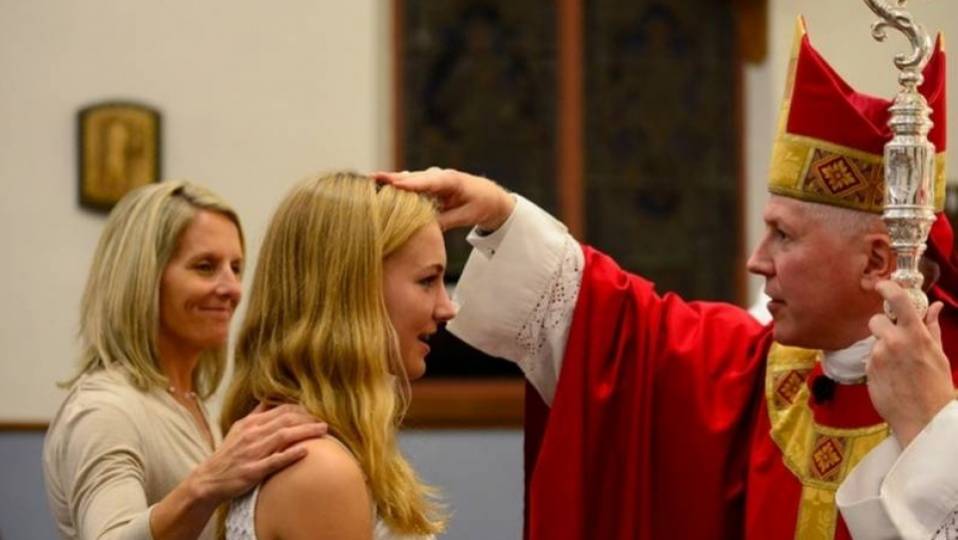
Alt text: Bishop anointing a candidate during Catholic Confirmation ceremony, symbolizing the outpouring of the Holy Spirit.
The Symbols in Confirmation: Signs of Divine Grace
Symbols enrich the Sacrament of Confirmation, conveying profound spiritual realities through tangible signs. Chief among them is sacred chrism, the perfumed oil that signifies the sweetness of Christ's virtues and the Holy Spirit's anointing. As St. Cyril of Jerusalem taught, "The body is anointed with visible ointment, but the soul is sanctified by the Holy and life-giving Spirit."
The dove represents the Holy Spirit's gentle descent, as at Christ's baptism (Matthew 3:16), bringing peace and purity. Fire symbolizes the Spirit's transformative energy, purifying and enflaming the soul with zeal, echoing Pentecost's tongues of fire.
The imposition of hands, performed by the bishop, invokes the Spirit's power, as in apostolic times (Acts 8:17). The sign of the cross during anointing marks the recipient as Christ's own, ready to bear witness even unto martyrdom.
These symbols—oil, dove, fire, hands, and cross—illuminate Confirmation's role in fortifying the faithful against evil, fostering devotion and moral fortitude.

Alt text: Dove and fire as symbols of the Holy Spirit in Catholic Confirmation, representing peace and divine energy.
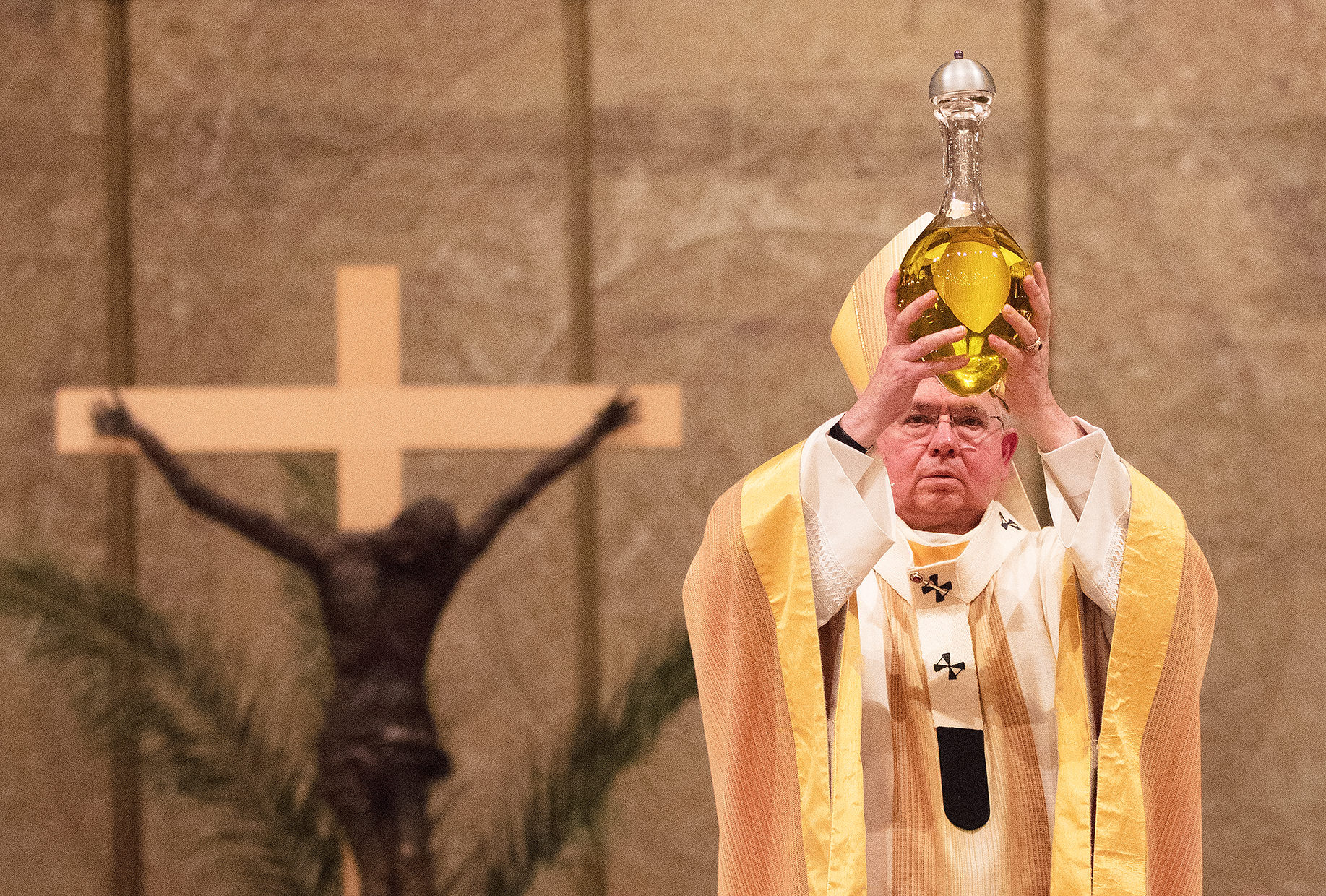
Alt text: Sacred chrism oil held aloft during consecration, essential to the Sacrament of Confirmation in Catholicism.
The Effects of Confirmation: Strengthening for Sanctity
The effects of the Sacrament of Confirmation are manifold, as outlined in the Catechism (CCC 1303): it brings an increase and deepening of baptismal grace. Firstly, it roots us more deeply in divine filiation, enabling us to cry "Abba! Father!" (Romans 8:15). Secondly, it unites us more firmly to Christ, intensifying our incorporation into His Mystical Body.
Thirdly, it augments the gifts of the Holy Spirit within us, empowering wisdom, understanding, and fortitude for virtuous living. Fourthly, it perfects our bond with the Church, making us active participants in her apostolic mission. Finally, it bestows a special strength to spread and defend the faith as true witnesses, confessing Christ boldly without shame of the Cross.
This indelible character marks the soul eternally, preventing repetition and creating a spiritual relationship with the bishop and sponsor. In essence, Confirmation equips us for eternal salvation, urging a life of prayer, sacraments, and service to God and neighbor.

Alt text: Young Catholics receiving the Sacrament of Confirmation, anointed by the bishop for spiritual strength.
Preparation for Confirmation: A Journey of Faith and Devotion
Preparation for the Sacrament of Confirmation is a sacred journey fostering spiritual maturity and commitment to Catholic teachings. Candidates, typically adolescents who have reached the age of reason (around seven, but often later in the West), must approach with an open heart and mind.
Key steps include attending catechetical classes to deepen understanding of the faith, regular participation in Sunday Mass and Holy Days, and frequent reception of the Sacrament of Reconciliation to ensure a state of grace. Daily prayer, especially invoking the Holy Spirit, is essential for growth in faith, hope, and charity.
Choosing a sponsor—a confirmed Catholic over 18, living virtuously—is crucial; they guide and exemplify the faith. Selecting a confirmation saint whose life inspires imitation aids in fostering devotion. Service hours in the community cultivate charity, while reflection on one's baptismal call prepares the soul for this seal.
As the Council of Baltimore emphasized, Confirmation is obligatory for those aware of Church precepts, particularly in facing trials. This preparation orients the candidate toward a life of sanctity, echoing the apostles' vigil before Pentecost.

Alt text: Confirmation sponsor supporting a candidate during the sacrament, highlighting guidance and witness in Catholicism.
The Role of the Holy Spirit in Confirmation
Central to Confirmation is the Holy Spirit, the Third Person of the Blessed Trinity, who animates the Church and sanctifies souls. As Paraclete, He consoles, teaches, and fortifies, as promised by Christ (John 14:26). In Confirmation, the Spirit's gifts enable the confirmed to bear fruits like charity, joy, and peace (Galatians 5:22-23), combating vices and promoting virtue.
This outpouring mirrors the Spirit's role in creation, the Incarnation, and the Church's birth at Pentecost. St. Basil the Great extolled the Spirit as the source of holiness, illuminating minds and perfecting baptismal regeneration. Devotion to the Holy Spirit through prayer, such as the Veni Creator Spiritus, deepens this relationship, guiding the faithful toward union with God.
Conclusion: Embrace the Seal of the Holy Spirit
In the timeless wisdom of the Catholic Church, the Sacrament of Confirmation stands as a divine summons to heroic virtue and apostolic fervor. By receiving this sacred seal, we are empowered to live as true disciples of Our Lord Jesus Christ, defending the faith with courage and radiating His light in a darkened world. Let us heed the words of St. Thomas Aquinas: Confirmation is the sacrament that promises the Paraclete's coming, fulfilling Christ's pledge.
Dear reader, if you have not yet received this sacrament, seek it with fervent prayer and preparation, entrusting yourself to the Blessed Virgin Mary, Star of Evangelization. For those confirmed, renew your commitment through daily devotion, frequent sacraments, and acts of charity. May the Holy Spirit enkindle in us the fire of divine love, leading us to eternal beatitude in the communion of saints.
Suggested Links:
- Catechism of the Catholic Church on Confirmation - Official Vatican resource for doctrinal depth.
- New Advent Catholic Encyclopedia: Confirmation - Historical and theological insights.
- USCCB: The Sacrament of Confirmation - Practical guidance from U.S. bishops.
- Eternal Word Television Network (EWTN): Confirmation Resources - Devotional and educational materials.
- Aquinas Institute: Summa Theologica on Confirmation - Scholastic perspectives for advanced study.